Our surprise arrived suddenly ... or maybe pleasant shock is a better description. It all began during a visit to the Taronga Zoo in Sydney, Australia. I'll digress for a minute to say that Taronga Zoo is a great place to visit with it's beautiful setting and collection of animals. There is a very, very large aviary with a wonderful group of large Psittacines (parrots) ... especially the Cockatoos that Australia is so famous for. Some of these aviary birds were so friendly that they flew right over to where this parrot lover was standing so I could really get a close up view and chat with them for awhile. What can I say ... it was wonderful! The Taronga Zoo also has some unbelievable views of Sydney and the harbor. So it's a great place to visit just for the view in case the animals aren't enough reason to visit. Of course, they were the draw for me. Taronga also has some interesting educational shows about Australia's native species so the visit really couldn't have been a better experience.
Back to the surprise I mentioned. While we were having lunch it arrived in the form of a Kookaburra. There we were, my brother and I, having a burger and fries at a small patio table. All of a sudden a wild Kookaburra flew right down to our table (not over a few inches away from my hand) and relieved us of one of our french fries. Needless to say, we were delightfully startled. And it was fun to watch him devour the fry on a nearby tree branch. Then he decided he needed another fry and returned for a second one. The people at nearby tables were as entertained as we were. It was pretty obvious that this wasn't the bird's first people-food snack. But for these American visitors his desire for fast-food made our day.
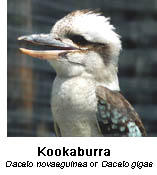
Some have described the Kookaburra as a plain-looking bird. Perhaps so, as it's back and wings are usually brown. However, in my opinion it isn't dull or uninteresting at all. In fact, I find them very attractive. The Kookaburra's overly large head (as compared to the rest of it's body) is creamy white with a brown eye stripe and very large beak. The bird is approximately 18 inches long (45 cm) and weighs close to a pound. Kookaburra's get all the moisture they need from their food so drinking isn't necessary. (Although I wonder how our visitor felt after eating the high salt content of those fries!) Their nests are built in hollow trees or even a termite mound.
Kookaburras are fascinating birds. They are members of the Kingfisher family and are famous for their racous "laugh" ... thus being nicknamed the "laughing Kookaburra". Many people around the world are familiar with it thanks to Hollywood films in which the laugh is the background in most every jungle whether the setting is in the Amazon or Africa (the bird is not native to either of these places though ... but that's Hollywood for you). In lieu of having sound to share in this weblog, their call can be described as beginning with a low 'oooo' chuckle that increases to a high "ha ha ha" and then back to a low chuckle. There isn't much doubt that it would be instantly recognizable upon hearing it. The Kookaburra's loud laughing call travels far through the forests where others of its kind hear it. The call is used both in courting rituals and for claiming territory.
But the Kookaburra call is not the only interesting feature of the bird. It has also adapted to it's environment in some unusual ways. And, as evidenced by our zoo encounter, Kookaburras have even adapted to humans with some even becoming tame enough to be handfed.
This bird is indeed a survivor ... living in the woodland and open forests of Australia and also Tasmania were it has been introduced. The Kookaburra is a terrestial Kingfisher. Unlike most Kingfishers, it doesn't catch fish but rather it's diet consists of lizards, mice, small birds, and an occasional snake. One of it's unusual behaviors is the way it kills prey. Kookaburras have been observed taking their catch high into the air to drop it, or they smash in on a tree branch. SIDEBAR - When we lived in Florida I watched a Belted Kingfisher (Ceryle alcyon) preparing it's meal of fish by repeatedly bashing it against our boat dock. That Belted Kingfisher landed on the dock daily as he cruised his territory. His visits (infrequently accompanied by a mate) were so dependable that I watched for him everyday. It was an added bonus when he caught a fish from the dock and I was able to observe his eating behavior. I was told that Belted Kingfishers repeatedly smash the fish to break the bones to make it easier to eat. I don't know if that is true ... it may just be done to kill the fish.
Kookaburras mate for life and have an unusual parenting behavior. They breed from September to January laying pure white eggs about the size of a Bantam chicken. The clutch size varies from one to five eggs with two to four eggs being common. Kookaburras lay eggs a day apart and incubate them between 24-26 days. After the young are reared and fledge they often stay around the nest to help the parents with the next clutch of babies. This behavior contrasts dramatically with the majority of birds who leave the nest once they are fledged to search for territory and mates of their own. When a Kookaburra family-system of chick rearing has been established it is usual for a second clutch of chicks to be raised in one season. In this instance, the offspring of prior clutches will take over the raising of the first brood of the season while the parents attend to the second. In a Kookaburra family group all the birds develop a brood patch which is a bare spot of skin on the breast used to transfer body heat to incubate the eggs. There have been documented cases where the helper birds spend more time incubating eggs than one of the parents. Most helpers are males who assist with nesting duties as well as territory defense. If a parent dies often a helper will take the place of the missing mate. SIDEBAR - Acorn Woodpeckers (Melanerpes formicivorus) have been studied and shown to use the same cooperative breeding method.
Having a close enounter with a wild bird gave me a great reason to learn more about the species. Spending a little extra time delving into the facts about birds has proven time and again that birds have fascinating stories to tell. It's one reason I'll continue to keep learning about as many species as this lifetime allows.
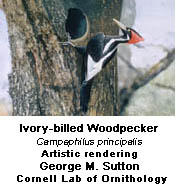
 I watched 60 Minutes on CBS last night! It was a great opportunity to learn a little more about the re-discovery of the Ivory-billed Woodpecker ... otherwise known as the Lord God Bird. According to Ed Bradley's report the woodpecker was called the Lord God Bird because it was so beautiful and impressive that when people saw it they said "Lord God ... what a bird".
I've never been to Arkansas and from what I saw on the show it has an incredible natural world called the Big Woods, where the Ivory-billed Woodpecker has reported to have been sighted. It was described on the show as "... one of the most exotic and the most inhospitable environments in America, a vast primordial ooze (swamp), a place so wild, the Big Woods have been called this country's Amazon". Needless to say, I am grateful for the opportunity to see it again on my computer.
The re-discovery of a bird thought to be extinct is exciting beyond words. For myself, I can only be thankful if such an event has taken place and the world may once again know and perhaps be given a second chance to delight in the beauty of an awesome bird.
I hope the news remains positive about this discovery and not end in a situation like the Spix Macaw in South America. When I heard that a Spix Macaw had been sited in Brazil in the early 1990's, it turned out to be the last one in the wild. Continued sitings of the bird lasted over a few years, the last in 2000 ... and then reported perished in 2001. How incredibly sad. Hope for the future of this bird remains in the hands of the few breeders trying to save the species with the handful of remaining individuals in captivity. With a limited gene pool I wonder how successful they will be.
To think of how incredibly short-sighted and heartless it is to destroy species as well as ecosystems is hard to fathom. Thank goodness we live in a more enlightened time where there is now concern felt for these issues and people taking action. Perhaps the Ivory-billed Woodpecker has been found and still has a chance for survival. If it does exist perhaps it won't end up vanishing like North America's only parrot, the Carolina Parakeet that was hunted to extinction in the early 1900's ... along with the demise of so many others. For me, I celebrate the discovery of the Ivory-billed and pray for it's future and good fortune.
 It was the warm San Diego sun that beckoned me to the outdoors and, specifically, to my hammock. My home is so sheltered by trees and foliage that it stays very cool and actually feels chilly at times. So I couldn't resist setting my computer work aside to take a quick catnap in the sunny warmth outside. My hammock is hard to resist . . . it is soooo comfortable with a feather pillow under my head and a glass of iced tea. I lost track of the number of times that is has proven to be "the place" to take a short refreshing nap or just relax to relieve some built-up stress. I don't think I could survive as well as I do without it. The other great thing about the hammock is that it rests on my deck about 4-5 feet from one of my hummingbird feeders. I just lay quietly in the hammock and get some wonderful views of the irridescent little gems that come to feast on the nectar. Ah, the best of both worlds . . . lots of comfort and some great bird watching.
Today, as I lay in the hammock getting my dose of Vitamin D for the day from the sun, I witnessed a true hummingbird battle. Now it isn't unusual for the hummers to be chasing each other away from the feeders . . . each trying to assert their dominance over it. But today, the sound of clashing beaks startled me and opened my eyes to witness two hummers battling about 4 feet away. It was an amazing demonstration of how aggressive these little guys can be with each other. The battle only lasted for a few seconds but it seemed longer as I watched them fly at each other repeatedly to do their little sword-like battle. It ended in seconds without injury (as most bird aggression does) when one of the birds finally decided to fly off to a nearby tree. Of course, that was only momentary, too . . . as a few seconds later he was back to chase the other bird away from the feeder.
There are a number of hummers that come to my feeders regularly. I can identify some of them by their habits as well as their species and markings. They seem like old friends . . . and in a way they are. The two most common visitors are Black-chinned (summer visitors, although they are still here now in early October) and Anna's who stay in the San Diego area year-round. I'm fortunate to have at least one species here all the time, so I always keep my feeders full.
My style of hammock-oriented hummingbird watching is just the ticket for me. You might find it fun, too. Hammocks!
 Where do you go for news about birds? One great place is The Cornell Lab of Ornithology, of course. It's easy to subscribe to their emailed newsletter. More about how to contact them in a minute.
It was a pleasure to hear some good news about endangered birds in the online newsletter:
Far from a backyard visitor, the Attwater's Prairie Chicken is critically endangered. To make matters worse 20 of the last 40 remaining birds live in Texas City, TX at the Texas City Prairie Reserve. The worst part has to do with Hurricane Rita. The Reserve Manager, Brandon Crawford, was out of state at a conference during the recent bad weather and rushed back with 1-gallon ziplock body bags in hand expecting to find the pairie chickens killed by the hurricane. But what he found was all 11 radio-collared birds giving off live signals. He was in shock ... pleasantly shocked to be sure, especially since 7 of the collared birds had been released a little over a month before. The death toll of released birds is highest in the first month. He feels that the uncollared birds may have fared just as well. Hope so.
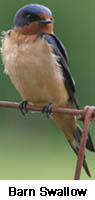
A graduate student, Rebecca Safran, doing research at the Cornell Lab discovered some intriguing facts about Barn Swallows (see photo above). Here is what she discovered. After Barn Swallows pair up for the season the females constantly judge their mates by their looks. The females evidently prefer their mates to have breast and belly feathers more reddish in color. Through DNA testing, Ms. Safran found that females mated to males with paler feathers were more likely to secretly copulate with another male. Hmmmmm!
The Cornell Lab of Ornithology is the place to keep up to date on the latest information about the rediscovery of the Ivory-billed Woodpecker which was believed to be extinct. You can even hear a Monday Night Seminar Series that includes information about this bird ... as well as a lot of other information. The seminar is presented by Tim Gallagher, Editor-in-Chief of the Lab's Living Bird magazine. The seminar is available through the Lab's Website if you have a broadband Internet connection.
If you are a backyard bird feeder and enthusiast you might be interested in the 18th annual Project Feeder Watch. This year's event begins in just a few weeks. Project Feeder Watch is an annual survey of birds that visit feeders in the winter. I'm going to participate this year ... perhaps you'll consider signing up, too. Anyone can join and become a "citizen scientist" for a few weeks. It is a lot of fun and contributes important statistics to the real scientists at the Lab. To learn more about this event or to register U.S. residents can call the Lab toll free at (800) 843-2473. In Canada contact Canada Bird Studies toll free at (888) 448-2473. In return for your $15 participation fee ($12 for Lab members, $35 for Canadian residents) you'll receive the Feeder Watcher's Handbook, a colorful poster of the most common feeder birds, a calendar, complete instructions on how to file your reports, the new Feeder Watcher's Year in Review, and a subscription to the Lab's newsletter BirdScope.
If you aren't a member of the Cornell Lab of Ornithology and would like to learn more you'll find a link to the Lab's website on the Birdwatchin'.com Resource page. The Lab's link is found under Wild Bird Organizations/Clubs. Don't miss the other good resources at Birdwatchin.com.
 I've really dropped the ball, so to speak. I never intended to have such a long delay between posts. My excuse this time is being 100 percent focused on lots of home projects and yard work. I love the results of all the hard work, but am frustrated about ignoring the computer-side of my life for so many days. I thought my next weblog would be about my backyard bird feeding experiences. Actually, I'd planned to chat about feeding American Goldfinches, but I'll leave that for next time.
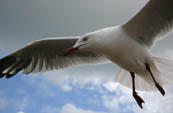
I have an unusual lifestyle to some. I've been married forever ... or so it seems. The unusual part is that my other-half lives in New York full-time because of work, while I Iive in California. I'm a CA native and prefer being "at home" in San Diego. What can I say other than that. Anyway, my husband is out here on vacation and wanted to pick up some medical supplies in Mexico while on the west coast. So off we went. Once we reach the international line the visit over the border usually takes about an hour or so. But we had to wait for delivery of the products my husband was buying. The delay meant time to grab a bite to eat. For anyone who has visited the area just across the border you probably know what shopping and/or eating in the border area is like. As we crossed a courtyard to find food, employees working in the various restaurants rushed over to convince us their eating place was the best. The guy tooting a horn (for attention) practically grabbed and drug us to his tables. We chose a table set outside so we could enjoy the beautiful weather. Just after my Margarita was served the "bomb" dropped. I'm not sure what kind of bird it was but we were served with a very unwelcome, very large "splotch" from above as the bird flew over. I guess I don't have to be any more graphic. Most of the splotch fell on my husband and I got enough have a mildly unpleasant experience ... and have my Strawberry Margarita ruined. The responsible culprit was a seagull. So I bet you can imagine how big the splotch was that covered my husband. Thank God he had a ball cap on his head. But all was not lost ... we cleaned up, moved inside and sat at a protected table. But I guess to be truthful our appetites were a bit ruined. A fresh Margarita was in order and helped to fade the experience slightly. Eating alfresco is great as long as you can see the humor in unexpected events. No problem for me ... I share my life with pet birds, lol. Although I must say in defense of my pet parrots that all together they don't even come close to the mess one seagull can make.
 It has been such a busy week with virtually no time to devote to Birdwatchin' Buzz. A sad state of affairs to be sure. However, I do want to to leave this short, but important note. For all of you that love birds and reading blogs about birding experiences don't miss the 5th edition of I and the Bird. For those of you who haven't discovered I and the Bird . . . it is a blogging carnival for people that love birds. Birdwatchin' Buzz was invited to submit a blog to this edition . . . a first for me. And what a crowd of talented and interesting writers I found myself among. Whew! You'll discover that John (of DC Birding Blog) who is the host of this 5th issue has cleverly listed the blogs in the format of a conference agenda . . . including shade-grown coffee breaks, time for lunch, etc. It adds to the fun! Don't miss I and the Bird . . . you'll really enjoy it!
 I can't believe that almost a month has passed since my last log note. It wasn't my intention, but rather due to the unexpected death of my brother under tragic circumstances. Needless to say, it has been a very sad and heartbreaking time for me. His death rendered a hole in my heart that will never completely heal. He was my only sibling and we were very close. My notes in this log were always planned to bring positive and happy circumstances to anyone who happened by to read them. So mentioning this event is to explain my unplanned delay in writing about the one area of my life that consistently brings joy . . . my pet birds and feeding those in the wild. It is also offered as a small remembrance for my brother.
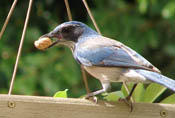
Although I've cared for pet birds for more than 20 years, it was my brother who first showed me the pleasure of feeding wild birds. I was instantly captured by the frantic activity of his Western Scrub Jays that we have here in California. It was during a visit to my brother's home that I discovered how much pleasure a simple hanging platform bird feeder can add to a bird feeding program. Actually, it was due to watching my brother add peanuts in the shell for his Blue Jay visitors that instilled the dedication I now have to feeding backyard birds. Thanks to you always, Brandon.
He'd pile the peanuts high in a swinging platform feeder and the Jays would come. Well, to tell the truth, he would wait until he saw a Jay nearby (they were always about) to fill the tray. The bird activity at the feeder was instant and so much fun. The Jays select the best peanut they can find on each visit. And they sure are selective or so it would seem. I've watched them pick up peanut after peanut until they find the right one. Then off they fly with it. One peanut at a time. Do they eat the peanuts? Nope! They hide them for a future meal. So they come to the feeder to steal away the next peanut until they are all gone. I'm sure that if I could put a 50# sack of peanuts on a platform feeder they would not rest until all the peanuts were safely hidden away.
When I got my own hanging platform feeder the Jays came immediately. I watched the first one take a peanut and fly right down to the backyard lawn. Later I checked the spot . . . sure enough, the Jay had hidden away the peanut deep down in the grass. Having a platform feeder turns into quite an adventure if you have Jays around. When I began feeding them there was only one. Now the number has grown to four or five. Four of the five seem to come and go. But one is always around. I believe he may be a baby born this past spring. He watches the Orioles and has decided the grape jelly I feed them is perfect for him, too. I don't know if anyone else has Jays eating grape jelly, but I expect so since Jays are very ominvorous.
I don't expect a day to pass by without loving thoughts of my brother. I'll continue to miss him terribly . . . and especially so when I offer peanuts to the Jays. Brandon, Birdwatchin.com is dedicated to your memory.
 Last summer I saw my first flash of gold and black at one of the hummingbird feeders. It definitely was only a brief glimpse, but long enough for me identify the bird as an Oriole with the help of my trusty field guide. Later I was able to narrow it down -- the bird was a male Hooded Oriole. I saw him occasionally then . . . but this summer has been different. All I can say is "wow" because a family of Hooded's have taken up summer residence near my jelly feeder. As far as I can tell the family consists of one male, his mate and at least one female offspring. The jelly feeder never seems to stop swinging from the constant visits. The feeder hangs under my patio deck roof so is very close. That is a good thing because I've discovered these birds are very flighty and do not stay long in one place. They are nervous around humans they can see nearby. That is very different from the more tolerant Goldfinches that I can approach as they hang on the thistle feeder. So having the Oriole feeder very near provides a great view of these beautiful birds from inside the house.
Since I live in California the Hooded Orioles that visit us are the Western species which are more golden in color than the orange of Eastern variety. I lived in Florida for a few years in the 90's but never saw an Eastern Hooded Oriole. I won't digress into my great bird experiences in Florida today. I'll find another time for that.
My stepdad, who lives with me, recently purchased a remote video camera. He has been working diligently to get it setup near the bird feeders so I can share what goes on in my backyard at Birdwatchin.com. The project has been challenging but he's making progress. As soon as the camera is working outside near the Oriole feeder the next step will be to show the live feed online. He's determined so I hope he'll succeed.
My Oriole feeder is designed to hold half an orange above a little dish that offers jelly or mealworms . . . both Oriole favorites. Well, to be truthful, I never got around to adding mealworms because once I provided jelly the Orioles have fed consistently . . . all day long, everyday. I should get some mealworms to thank them for being so entertaining before they head South for the winter. By the way, if you want to feed Orioles jelly make sure it is grape jelly. Just buy an inexpensive brand . . . I pay between $1-2 for a 32-oz jar. I have to warn you, Orioles are eager eaters so be sure to keep jelly on hand. Also, be sure that the dish you provide the jelly in is shallow. I read about a lady who had to rescue and rehab a baby songbird when it fell into the jelly and got mired up to it's little head. Also, put your jelly feeder in the shade to keep it fresh. If your Orioles don't eat the jelly as fast as the ones I'm feeding be sure to replace it every few days. I refill my jelly dish about twice a week because the Orioles empty it completely that often. My jelly dish feeder holds about 1/4-1/2 cup.
Orioles are attracted to the color orange -- in the same way hummingbirds are attracted to red. You can provide an orange-colored Oriole feeder if you are feeding nectar. However, my Orioles fed at a hummingbird feeder even when I had a small Oriole feeder available. I just drilled a couple of larger holes in the plastic base of my feeders to accommodate their larger beaks. You can make your own Oriole nectar which is a little different sugar-to-water ratio than you feed Hummingbirds. However, I would put the Oriole nectar in an Oriole feeder . . . not a Hummingbird feeder because the ratio wouldn't be appropriate for Hummers.
With the jelly available, the Orioles in my yard have pretty much ignored the Hummingbird feeder until recently. In the past few days they have emptied nearly 2 cups of nectar. This fast consumption of nectar is so unusual that I'm wondering if it has something to do with our hot summer weather arriving. Maybe they are thirsty. Yikes, if that is true it makes me feel guilty. I've been looking for a water source -- such as a bird bath with moving water. I haven't found what I'm looking for yet. I'd better get a move on. I'll let you know what I come up with. Here's something funny about the Orioles drinking all the hummingbird nectar. The Black-chinned Hummer that called that particular feeder his own has now set up residence by perching on the feeder to protect it from the Orioles. Hummers are very aggressive about their feeding sources. I guess this little guy is going to do his best to make sure those big bully Orioles leave his food alone.
Orioles are migrating birds. Fall is just around the corner and our Western birds will head for southern destinations in Mexico. I'll really miss them when they leave. Since I'm in Southern California where we enjoy a moderate climate I wonder if my Orioles will leave. They are pretty attached to my feeders. But nature has programmed them to fly South so I expect them to migrate. If they go I'll just have to wait for their return. Birds remember where they find food so there is a good chance these same ones will come back in the Spring. I sure hope so. I'll be waiting and the feeders will be full.
Thanks for visiting the first weblog of Birdwatchin' Buzz. I'm a bird lover . . . yep, that's me! This crazy fascination began years ago when my Dad brought home two pet cockatiels . . . quickly named Junior and Pancho. They were lovable, sweet and real characters. I was mesmerized. But it wasn't until years later -- I was in my early 40's -- that the fascination led me down a life-path devoted to birds. I brought home my first large parrot 20 years ago and since then my avian family has grown to 15.
But you're thinking this weblog is about backyard bird watching, so why mention exotic pet birds? Afterall bird watching is all about the wild birds that visit our backyards and those we search for beyond . . . not those that live with us. Be sure that I won't stray far from bird watching -- in fact the next weblog will be about the wild birds that are visiting my backyard this summer.
For now, I just wanted to say "hi" and tell you a little about my bird family. In fact, if you'd like to know more about us read How 13 Birds Became a Family. I believe there isn't a better way to appreciate bird behavior, intelligence and personality than living in daily contact with birds that bond with you. This daily experience is responsible for exploding my interest in identifying, feeding and watching birds in the wild.
If you love bird watching and feeding birds in your backyard, or have pet birds, or just enjoy animals and nature in general come back for another visit. I'll welcome comments about your interest in birds and animals. I'll do my best to help you find the answers to questions you may have, so be sure to pass them along. Again, thanks for visiting, it's great to connect with another bird-lover!

 Our surprise arrived suddenly ... or maybe pleasant shock is a better description. It all began during a visit to the Taronga Zoo in Sydney, Australia. I'll digress for a minute to say that Taronga Zoo is a great place to visit with it's beautiful setting and collection of animals. There is a very, very large aviary with a wonderful group of large Psittacines (parrots) ... especially the Cockatoos that Australia is so famous for. Some of these aviary birds were so friendly that they flew right over to where this parrot lover was standing so I could really get a close up view and chat with them for awhile. What can I say ... it was wonderful! The Taronga Zoo also has some unbelievable views of Sydney and the harbor. So it's a great place to visit just for the view in case the animals aren't enough reason to visit. Of course, they were the draw for me. Taronga also has some interesting educational shows about Australia's native species so the visit really couldn't have been a better experience.