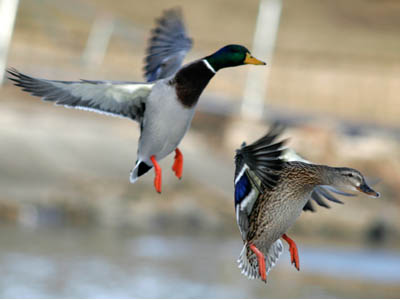
One of the best ways to attract birds to a backyard feeding program is to offer a ready source of cool water. This is especially important during our months of warmest weather. This need becomes critical in certain parts of the country such as those that are currently experiencing extreme hot weather. If you do not already offer a fresh source of cool water for your backyard visitors I encourage you to add one. Not only will fresh water attract birds under normal circumstances ... it is the highly recommended way to attract birds to your yard ... your feathered visitors need your help during the currently extreme hot weather conditions.
It is interesting to understand why a source of cool water is so important to birds. David Allen Sibley, author of The Sibley Guide to Bird Life & Behavior provides an excellent explanation: "Although birds lack sweat glands, they can perspire through their skin and thus reduce body heat. Birds can also get rid of excess body heat by panting, which allows water to evaporate from the surface of the air sacs." Continuing, Sibley explains: "The challenge is both of the above cooling methods are dependent upon a ready source of cool water".
While having a fancy birdbath may be appealing to us, it is not necessary for the birds. Something as simple as a clay saucer or upturned garbage can lid kept refreshed often with clean, cool water will provide an extra water source during extreme heat as many areas are experiencing now. However, one thing we know is that moving water attracts 10 times more birds. There are products that can address this need. A simple way I've used is to hang a plastic pot for plants above my bird bath. Before filling with water make a very tiny hole in the bottom so the water can slowly drip into the bath. Good advice is to start with a really tiny hole as you can always enlarge it if you need more water to drip. Using this type of container (milk jug or bucket) is a quick way to provide moving water, but you do need to refill the container, as necessary.
 If refilling the container might prove inconvenient, products like the Water Wiggler can be put in your bird bath. The Water Wiggler runs on batteries that make its legs jiggle keeping the bird bath water constantly moving. The Water Wiggler I use runs on 2 D-cell batteries which keep the Wiggler moving 24-hours a day for 3 months. Actually, I went a step farther and purchased the Water Wiggler Aurora which provides a gradually changing rainbow of colors casting a soft glow on my deck at night. The colored light turns on automatically at dusk and glows for 3 hours and then shuts off automatically. However, only the light shuts off as the Water Wiggler provides continuous water movement as mentioned.
 Another appealing way to help songbirds stay cool is a device called the Easy Mister. It simply screws onto the end of garden hose. Just hang the hose over a tree limb or garden hook. The product puts out a fine mist that birds love to fly through and is especially helpful for Hummingbirds. When it is placed where leaves get wet songbirds birds love to take a "leaf bath" by rubbing up against the wet leaves. It doesn't cost a lot to operate as it only uses one gallon of water per hour.
Please don't forget to provide water for all our feather friends as they truly need and appreciate it. They'll fill your backyard with brilliant color, intriguing behavior and beautiful song as a thank you.
As a huge fan of backyard bird feeding I found a recent article provided by The Cornell Lab of Ornithology's Living Bird very interesting. The article focuses on the use of RFID (radio frequency identification) to monitor individual birds feeding habits by placing the RFID tag readers on various feeders in the woods near the Lab. Tiny 0.1 gram tags were placed on the legs of 129 bird species that frequent backyard bird feeders ... that is, specifically Black-capped Chickadees, White-breasted Nuthatches, Tufted Titmice and House Finches. According to the article only 6 hours of feeder upkeep per week provided 8,000 hours of continuous observations with some surprising results. Read this fascinating article.
Thanks to the following Cornell Lab eNews article received yesterday on the endangered Spoon-billed Sandpiper, a rare shorebird that breeds in the Russian Arctic, I discovered this unusual species. What a beautiful bird with such an unusual shaped beak. Very cool! Best wishes to the scientists on their mission to save this species from extinction. While it is sad to think that wild birds will be put in a captive breeding program and thus be removed from their natural habitat and life ... the greater tragedy would be the loss of this species forever. Here is the article and beatiful photo of this cool bird ...
Cornell Lab eNews
June 22, 2011
A Rare Chance for the Endangered Spoon-billed Sandpiper
An unusual shorebird with a one-of-a-kind bill is facing extinction--and a team of scientists from the Wildfowl and Wetlands Trust and Birds Russia are doing all they can to save it. They've mounted an expedition to this species' breeding grounds in arctic Russia, hoping to establish a critically needed captive breeding population. Fewer than 200 breeding pairs remain on earth. The Cornell Lab of Ornithology's Gerrit Vyn has joined the team to capture rare images and sounds of Spoon-billed Sandpipers on their breeding grounds, including the photo above. Read more.
![]() While it took longer to find the time than I mentioned in my post last Monday, I was able to hang my new Fancy HummZinger Hummingbird Feeders this afternoon. I’m as happy with them as I thought I would be. They are going to be just wonderful to take care of … that is, they are so easy to work with that it will be a snap to clean and refill them every 2-3 days in my pusuit to offer fresh nectar to my visiting Hummers. Honestly, I think I’ll even look forward to it rather than moaning and groaning about yet another “chore” as I was somewhat in the habit of doing with my old small-neck bottle-style feeders that I truly disliked having to clean.
The photo in this blog post shows the new feeder, but it really doesn’t do justice to the overall beauty of it. I’ve always been willing to acknowledge the “satellite” style feeder had merit but I never found it aesthetically pleasing … until finding this feeder. Of course, I must admit that my bottle-style feeders weren’t the least bit attractive, but I opted to buy them because they held a lot of nectar. Well, as it turned out that wasn’t the advantage I thought it would be. The main reason is the nectar wasn’t all consumed before it needed to be replaced to keep it fresh for the birds. So along with frequent cleaning of a hard to manage feeder, I was wasting nectar, too. Well, that wasn’t really the critical point as I make my own nectar which keeps the cost down, but waste is still waste and it bothered me. Yes, I know I could have put less nectar in the feeder but that still wouldn’t have made the cleaning chore any easier. But I digress.
More than a pretty feeder, I discovered some cool things about the Fancy HummZinger:
- It is made of unbreakable polycarbonate with a cover than removes easily for cleaning and filling. And I do mean … easily! What’s more … the feeder is leak and drip proof!
- 12 oz. capacity that is the right size for keeping the nectar fresh. Unless you have a ba-zillion Hummers visiting your yard and you only have one feeder, this size feeder should certainly be fine.
- It has a built-in ant moat in the center that you fill with water to block crawling insects from reaching the nectar. So no more extra ant moat accessories need to be purchased to deal with that potential nuisance.
- But what about flying insects? Okay, that is also addressed with feeding ports that support Nectar Guard technology. What this means is there are Nectar Guard tips available, if needed … but they are sold separately.
- Another aspect of the feeder I really like is the brass hanging rod. Rather than just a plain old rod that most "satellite" feeders feature, this one has an ornamental look with its curlicue design at the top. The hanger portion of rod itself has an opening to accommodate any pole system. However, I hang my feeders under the house roof eaves suspended by chain to a length that allows a good view of the birds. To match the brass rod I purchased some brass chain, eye hooks, and “s” hooks from my local hardware store ... the addition of which made it easy to hang the feeders.
- Now the rest of the design is purely for the aesthetic appeal I mentioned. There is a pretty brass finial at the bottom of the feeder to give it that “finishing touch”. Now you might think “oh, oh” how can you set the feeder down on a flat surface and keep it level for filling. The designers of this feeder have thought of everything. It is simple to fill the feeder with the finial attached. You just easily remove and place the red cover on a flat surface and then rest the tray atop the cover. Doing that keeps the portion of the feeder you fill with nectar level. Then you just need to hold the feeder and replace the cover and hang. So simple!
- Lastly, the red cover is so, so pretty with is bright color (actually it is offered in rose red, which I purchased or a gorgeous fuschia). The feeder also has 4 embossed flower designed feeding ports which can't be seen very well in the photo. What Hummer could resist? Certainly not mine, lol.
- There is two more things about the feeder that is important to me, especially in today’s world ... The HummZinger is made in the USA … yea! … and comes with a lifetime guarantee.
For anyone reading this post who would like to begin feeding Hummingbirds, here are a few fast facts:
- Hummingbirds feed 5 to 8 times each hour and consume half their weight in sugar daily. So you’ll have lots of opportunity to view these little avian jewels by offering them a feeder.
- There are 16 species of Hummingbirds found in the U.S. and southern Canada at various times of the year.
- Hummingbirds locate their food visually, and will investigate colorful blooms for nectar. So it is great fun to beautify your yard with flowering plants that attract Hummingbirds, including begonias, fuschias, bleeding hearts, honeysuckle, hibiscus, geranium and yucca. Check with your local nursery for the appropriate types for your area. You might also want to check out Birdscape Your Backyard for general info and flowers for Hummingbirds.
- My new HummZinger Hummingbird Feeder offers a great design that certainly attracts Hummingbirds quickly and easily.
As with most folks that enjoy feeding wild birds I love attracting Hummingbirds to my yard. When my hummingbird feeders were originally offered I found that placing them near each other ... that is, where the birds could see each other visiting a feeder caused more than usual aggressiveness between the birds. Successful feeding meant placing the feeders where the birds didn't feel competition from each other. In order to do this so I could easily view the birds meant I could only hang two feeders. While I intend to experiment by adding another in the near future, right now I still only have two.
The problem with my current feeders is the difficulty cleaning them. Frankly, with my busy schedule the cleaning difficulty discourages me from changing the nectar often as recommended ... although I manage to do it, it isn't fun. I've thought about replacing the feeders for quite awhile, but until recently hadn't come across a feeder style I liked that was also easy to clean. That is, until now.
One of the bonuses of having a wild bird business such as BirdWatchin'.com, is the continual discovery of the thousands of products offered to wild bird feeding enthusiasts. Because I'm currently growning the site with the addition of bird watching supplies it has provided the opportunity to find the new hummingbird feeders I'm planning to hang in my yard today. Not only does this new feeder ... most importantly ... provide the ability to be quickly, easily cleaned with a design safe for the birds, but is also in my opinion quite beautiful!
My old feeders were the bottle-style with a very small opening to fill the feeder which also caused the difficulty in cleaning the feeder easily. Because of it's vertical style it also blocked the view when Hummers fed on the opposite side from where I was trying to view them. The new feeders have a horizontal satellite style which affords a full view of the birds no matter what port they feed from.
Unless my schedule goes awry today, I intend to put the new feeders up and see what the birds think of their beautiful new banquet tables :). I have a feeling they'll be pleased!
Next on my agenda to accommodate these backyard visitors is yet another feeder. I'm gong to install the third one just outside my office window so I won't miss the Hummers while I'm working. This feeder will be a different style and is touted to be the "best hummingbird feeder" ... hmmm ... we'll see. At least I'm assured it will be easy to clean with its wide-mouth opening. It sure won't beat the beauty of the ones I intend to hang today. But if it provides a way to attract more Hummingbirds then I'll be a fan. More on this new feeder in an upcoming post.
Christmas 2010 has come and gone and January 1, 2011 is 2 days away. Oh my gosh 2010 is almost history ... time sure has a way of flying by doesn't it? With thoughts directed toward the New Year I'm filled with anticipation about the expansion of BirdWatchin'.com to provide full-service to those of us that love backyard bird feeding and bird watching in general. While it will take a lot of time and commitment to bring a full complement of supplies and other goodies to the website, work will begin shortly and will continue to grow until the literally hundreds of exciting products fill the cyber-aisles of BirdWatchin'.com.
To be honest, the long delay accomplishing the full-service aspect for BirdWatchin'.com has been frustrating, but is entirely due to the time commitment it has taken to bring BirdCagePortal.com to the point of full service for those of us that are devoted to our pet birds. But with the new year approaching and Spring just beyond, I can't help but want to show all my backyard bird feeding friends how easy it is to invite and provide for wild birds with the great selection of feeders, houses, food, baths and so much more we will be offering! I'm beginning to acquire some great new stuff for my own backyard to add to old favorites ... what fun it will be to watch our bird visitors discover all that is new.
As anyone who has visited my blog in the past knows I'm a devoted Mom to a fairly large family of pet birds including Macaws, Cockatoos, an African Grey, Golden Conures and Lesser Jardine Parrots. They are my life ... along with also being Mom to a Mini Aussie, Mini Dachshund and four "inside" cats. Yes, it's a large family of critters, but we actually did some recent increasing with the addition of 8 hens. The new chickens were brought home at 2 weeks of age (more about them to come). I'm mention the new hens because they are birds ... and also pets. Although it will be unique to have them provide for us (i.e. eggs) rather than us just providing for them :). However, with only 2 humans in our household I fully expect to be supplying my neighbors with eggs, too! That will be fun. Until we became involved with these hens I had no idea about the growing interest that city people have in keeping chickens in their backyard. Many city ordinances have been changing to accommodate the growing interest. But just so you know, we don't reside the "city" ... it is nearby, but we are able to live in a more semi-rural area. But I think it is fascinating that city-folks are getting into the hobby of keeping chickens for the eggs they provide.
It will take time to grow BirdWatchin'.com according to plan ... but I hope you'll return to watch the change. And you might even find an item or two to help attract feathered visitors to your backyard and increase your enjoyment of them.
 I've decided I really need to clone myself, lol. That doesn't mean that I'm in great need or anything so dramatic ... it just would help to have more than one of me to do everything I either want or need to do. I suppose that is a common feeling among most people in today's world.
One of the reasons I feel need for a clone is to do a better job making posts to my blogs. After starting my first blog ... which admittedly was a little scarey in the beginning ... I've found it to be fun and kind of relaxing and stress-relieving. Blogging provides an avenue to "talk" about things wandering around in my mind and I feel better after chatting about the bird related things in my life. But because I have a lot on my agenda at the present time I'm not finding the time to post as often as I'd like to. Thus the need for a clone.
Since I've been pressed for time it was strange to find myself sitting down at the computer a few days ago and creating a second blog. However, I'd been thinking about creating it ... with a focus on pet birds ... for sometime and I suppose I found myself working on it because it was a pleasant diversion and the comfortable thing to do at the moment. The new blog is called Pet Bird Buzz! The word "buzz" means news to me as it relates to creating posts, so that is why I've used it in the title of both my blogs. If your love of birds extends to those we keep as pets come and visit the new blog. If you have comments or interesting pet bird experiences to share I hope you'll leave comments. One of the enjoyable things about having a passion that others enjoy is connecting and sharing information and experiences.
As far as my summer backyard bird visitors go ... the Orioles raised their family and have definitely departed ... perhaps it was time to start heading south. The Blue Jay now has the grape jelly feeder all to himself and is definitely taking full advantage. I'm beginning to wonder if grape jelly is all that good for him when he eats it throughout the day. I'm trying to keep the peanut feeder full to give him some food to cache away and to create a diversion from the jelly. But he takes ALL the peanuts to hide them away and does so until the peanut feeder is empty ... then its back to the grape jelly. I think this bird is becoming a bit spoiled, lol.
After going missing for most of the summer, with only an occasional visit, the male peacocks are back almost on a daily basis. Other than hanging around the front door (to look at their reflection in the glass panes) I'm glad to have them back. Having them at the front door just means cleaning up a little more bird poop ... which I have enough of with my pet birds, lol. Oh well, I suppose its okay since long along I had to admit that I'm a bird slave. But, I'm not complaining ... even the best life has to offer isn't always perfect.

The answer to that question boils down to just an extension of my last excuse. It's pretty embarrassing to make another entry that doesn't start off talking about birds ... but rather just to explain the absence of posts. It has everything to do with the continued work on the new BirdCagePortal website, which is now fully functional ... if not complete. It probably never will be truly "finished" because new products and content will be continually added. However, the pet bird supply shoppers have found it and seem to like what it offers. It is still sadly lacking in the kind of basic bird care information that I hope to include. So much to do ... so little time, lol. Anyway, it is progressing, however slowly. That is just the nature of website development.
Anyway, it has been a delightful summer of backyard bird observation. Once again our feeders were graced with the presence of Hooded Orioles ... with the added pleasure of having a pair raise a new family, once again. These birds love grape jelly and that seems to keep them coming back. I put up jelly feeders prior to their arrival in the spring and keep them up past the time they leave just to make sure they know they can depend on me, lol! Anway, I think I should buy stock in Welch's or Smuckers for the amount of grape jelly we purchased this year. It was much more than last year ... so perhaps we had more than one pair staking out the feeder. I've wondered whether last year's offspring might have wandered back in addition to the parents. It really was fun watching the parents bring their babies to the feeder. The little guys would hang on to the feeder and beg their parent to feed them. Finally, they caught on and began diving into the jelly themselves.
The jelly feeder holds a small plastic cup within a wooden platform and has a pitched roof over the top. The platform isn't very large so it was entertaining to watch one parent and two chicks trying to balance themselves on the feeder at the same time on a couple of occasions.
The only competition for the jelly continues to be our resident blue jay. I believe he watched the orioles and decided what was good enough for them was perfect for him, too. Just a couple of days ago we had some unwelcome competition from an ant colony who I believe were on the march to find water during a horrendous heat spell we are still experiencing. Believe it or not, the temperature has been in the low 100's eventhough we aren't more than 15 miles to the ocean ... as the crow flies. We haven't had ant problems until this very hot weather arrived. The ants were crawling over the jelly feeder on one day ... which perhaps discouraged the orioles from feeding ... but they were gone the next. Perhaps they were being urged on in their search for some water. I haven't seen the orioles since and I'm not sure if the ants discouraged them or it was time to begin heading south. I can't remember when they left last year, perhaps it was about this time.
The photo above is of my jelly feeder sans orioles. Actually, it is very difficult to get any photo (good or bad) of the birds at the feeder because they are very nervous by nature and fly off at the slightest movement or site of a human. Although I must admit they were a little more tolerant this year than last. But still impossible to photograph. Perhaps next year I'll be lucky enough to have them trust a little more. We'll see.
 It's been another long vacation from blogging. My last post was months ago ... I can't believe how weeks fly by. In a way, it seems like yesterday when I wrote that I was back to my a regular schedule of sharing my backyard birding life. Then poof! ... all of sudden so much time has flown by I have to admit my intention failed. I have an excuse ... it seems legitimate to me ... but doesn't go very far to reduce the guilt I feel in failing in my commitment to blog about wild birds. I suppose I'm the only one that really cares, but I really do feel bad mostly because I really enjoy sharing my thoughts and experiences about birds.
So what is my excuse this time? Well, rather than coping with sick relatives this time it has everything to do with birds. As some who have read my previous posts may have discovered, my bird passion includes pet birds. I have a family of them ... and it has been an amazing experience for the past 22 years. So what has been taking all my time to the point of failing to keep up my blog? I got an idea some months ago to create another website ... one focused on pet birds.
As you may know my first website Birdwatchin'.com is about bird watching and backyard birds. I loved putting that website together ... there's something about spending long hours that involve your passion that makes it not seem like work. But creating Birdwatchin.com only fulfilled a part of my focus on birds. Yes, I did share some stuff about my own birds the the website, but just a little. So I've decided to create this other pet bird website and that is what has been taking all my time. For anyone who has created a website you know how all encompassing such a project is ... sometimes to the detriment of other important interests. And so it was with me.
Anyway, I'm finally nearing the point of submitting the new website to search engines which means I'm close to finalizing the basic part of the site. So what is this new site about. Well, my intention is to have it become a place to get good pet bird care information, resources and great products at big savings. If you're a pet bird owner you should check it out.
Currently the website's product line consists of a large selection of quality bird cages, including stainless steel. But I'll soon be adding play stands, cage covers, a good selection of various pet bird accessories, bird toys, etc. You know, all the stuff pet bird parents must have to create that special environment their pet needs.
To keep the website current with pet bird news and fun stuff bird people enjoy there will be a free newsletter. Again, it will be edited by none other than one of my favorite bird pals, David Jeffrey.
If you are a pet bird owner you can visit this budding website at BirdCagePortal.com. You might want to bookmark the site so you can re-visit and watch it develop. I'll make another announcement when it is fully functional and not only ready for visitors, but shoppers, too! Hope you like it ... and if you're inclined give me your input or suggestions I'd love to hear from you. There's a contact form on the website ....and there will be Live Support when the site is fully functional. I really want to makeBirdCagePortal a website you'll enjoy visiting on a regular basis.
I just noticed the date on my last blog ... yikes, it was almost 6 months ago. I can't believe I've haven't posted in 6 months! But I suppose it is an example of how obligations and commitments to important projects can get completely out-of-hand and impact the bird watching lifestyle I prefer. Lately I've been paying attention to that "empty" feeling I've noticed lately. It finally dawned on me as I trudged along taking care of pressing projects that I was feeling out-of-sorts because I haven't been spending any time enjoying what I love most in life ... birds and the natural world. So, even though my projects are still needing my attention I'm going to find the time to enjoy my passion and post to my blog, too.
To be truthful, I've haven't even been a devoted backyard bird feeder lately ... and it really hurts to admit that. There has just been too much to do and so I couldn't keep the bird feeders cleaned and filled. I guess the only feathered friends that could really count on me this past summer were the hummingbirds that are here year-round. I did manage to keep them happy. I know that the birds don't rely on getting all they need from bird feeders and that helps me feel slightly better. But honestly, my guilt level is pretty high at the moment. So I hauled all the feeders out of storage and they are being rehung. Unfortunately, I'm not getting them up fast enough to participate in the Cornell Lab of Ornithology Project Feeder Watch ... their annual wintertime wild bird feeding project. So I'll just have to be content with my intention to register for it next winter.
Even without the bird feeders we had feathered visitors all year. That is typical here in the San Diego area. BTW, I encourage you to visit San Diego if you like to bird watch beyond your own locality. You won't be disappointed. One special experience this past spring was during an extremely hot period. We had a broken sprinkler and after it was fixed the system was turned on to make sure everything was working okay. Shortly after the sprinklers came on an adult male Cooper's Hawk swooped down into the spray and had himself a good soak ... flapping wings as he jumped and danced in the spray. I ran for my camera and warily made my way back as close as I could to the hawk. Surprisingly when I got back with the camera another hawk (that I assume was his mate since a pair of Cooper's had been nesting nearby) had joined him and they were both having a great time in the cool water. I was transfixed watching the amazing display and by the time I got ready to take a picture I discovered the camera batteries were dead. So I quietly retreated to the house for another camera and loaded new batteries to be safe. By the time I returned to my hiding place the active bathing was over and the female had flown to a nearby palm tree. I tried to get a good shot of the male who, by now, was just standing in the spray. I snapped a couple of shots and then he flew away to join his mate. Before I turned around to leave another hawk flew down to get his share of the cool water. Again I took pictures, but they were disappointing, too (as you can see by the photo above). However, it does show an immature Cooper's Hawk. My guess is that this youngster was this year's offspring of the pair bathing earlier.
Shortly after the hawk experience a close relative (and bird watching buddy) had emergency health problems which led to very serious surgery. Helping him recover ... and those projects I mentioned meant no more bird watching for me ... until now. I'm thrilled to be back!
Look for links to some wildlife cams in my next post.
Learn more about bird watching and backyard bird feeding.
 I've been in a 22 year love affair. Yep, I sure have. Who has captured my heart? Well, I'll give you a hint . . . he is wrapped in a bundle of the most beautiful feathers anyone can imagine. These feathers are soft, fluffy at times, and absolutely take your breath away. Are you familiar with the rose bush named "Peace". If you are then you know the color tones of my beautiful friend. If you don't, take a look at the photo. It's my beloved Fagan, a Moluccan Cockatoo posing with the "Peace" rose in my backyard.
I couldn't resist putting the two of them together and taking the picture to share. Although I have to admit my photographic abililty is not improving much because Fagan's beautiful peach-colored feathers look a bit washed out. What you see is the best I could do.
Fagan and I have been together since he was most likely 6-8 months old. Why the estimated age? Because he was captured in the wilds of Indonesia as a baby bird. The only thing about our relationship that saddens me is that he couldn't fulfill his destiny as he was intended. Back in the mid-80's the U.S. still allowed importation of wild caught birds. I was a novice and didn't realize the horrors the wild bird trade committed. So I happily supported the trade when I saw this absolutely gorgeous, sweet baby bird in my local bird store. It was love at first sight. It was later that I came to regret my participation in furthering the business of trapping of wild birds by purchasing him. But other than that, I have no regrets . . . not for myself, at least.
Living with Fagan has been wonderful. Getting to know him has been a fascinating adventure. But it hasn't been without challenges, frustrations and hard work. But even with that I'm so grateful to have had the experience and lessons he has taught me. I wish I could repay him somehow. But I can't -- I can't provide the natural life he should have had. All I can do is make the best life possible for him. Since he has thrived over the years, I suppose I've succeeded somewhat. He knows no other life and is content. He has someone who loves him and an Umbrella Cockatoo buddy. Owing to the fact that he is incredibly intelligent and extremely adaptable creature I think I can honestly say he is happy. For that I am very grateful.
One day last week I was in my backyard working madly away in a flower bed. It was in need of some general cleanup and removing dead growth left patches of bare ground. In the process of clearing away the vegetation I noticed a couple of caterpillars. Being the nature lover I am, I replaced them in the vegetation and went on with my work. After a time, our frequently visiting Western Scrub Jay appeared in the birch tree above me. She (at least I think it's a she) sat above me and seemed to be watching me work. Shortly, I discovered it wasn't me that she was interested in, but rather she'd spied one of the caterpillars who had crawled back out of the flowers. The jay patiently waited until I was ready to haul away the debris I'd accumulated. As soon as I was about 15 feet away the Jay swooped down and picked up the caterpillar. So much for my trying to "protect" the caterpillar!
Now here's the thing I'm confused about. The Jay didn't eat the caterpillar, but instead flew off with it. Now, that is certainly their habit with peanuts. They hide peanuts for later eating. But you can't cache a caterpillar so I assumed the Jay would have eaten the insect after catching it. But no, she definitely was taking it somewhere.
So, being springtime, I assume that her purpose of flying off with the caterpillar was to bring "baby food" to her nest. Seems reasonable. But then I wondered if this might be an immature Jay with the caching instinct even for bugs. I guess I really have to cast my vote for the "baby food" theory.
This Jay has done another interesting thing. It has developed a taste for the grape jelly we offer the orioles. Up until recently the Jay has come to the feeder and eaten the jelly. Now recently, I've witnessed her flying off with gobs of jelly in her beak. Is the caching instinct at work again? Or, is she taking grape jelly to feed young ones? Yikes, I hope not ... that doesn't sound like a good diet for growing nestlings. There is a little more protein in a caterpillar than grape jelly! Maybe I'd better go back out to the garden and dig around some more.
 One of the great joys in my life are my Lesser Jardine Parrots. They are the smallest parrots I have and occupy a place in my heart that none of my other avian kids can fill.
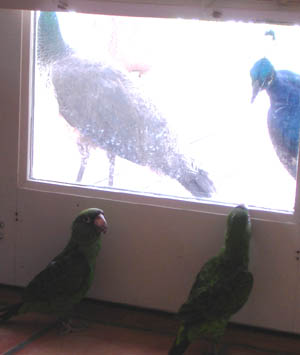
Jardines are known as the "African Amazon" alluding to the fact that they are very Amazon-like in personality and a little bit in appearance. Lesser Jardines are smallish-size parrots ... about 11 inches long. My Jardines are clowns. They have a funny little lilt to their walk, love to bounce around, roll on their backs, hang by one foot. Perhaps you're getting a visual picture. Adding "cute as a bug" will sum them up to a tee. They are also my best talkers . . . really they are quite gifted. They are also beautiful -- their feathers are the most amazing green color combined with black, with some of the green feathers being quite irridescent. As they get older red feathers appear usually on the head, edges of wings and also underneath the wings. The posed photo of Harry and Isabel depicts their color as well as a photo can. However, their colors are really more vibrant.  This photo shows two Jardine babies attracted to the window inspecting our visiting peacocks, which were just as curious about them. When I discovered this encounter I didn't have my camera close by, so missed the cutest photo-op. The Jardines were busy jumping up and down trying to get a better look. The peacock was showing just as much interest, but without the body language. Of course, I ran to get my camera and by the time I got back the peacocks had left the window. I waited for them to return while sitting scrunched up in the corner. It took long enough for my back to start hurting. As soon as they returned I tried to get a photo and all I managed to do was to startle the Jardines, who then turned into little statues when the flash went off. Oh, the trials bird photographers must go through. I hung in there as long as I could and finally got this shot, which is poor at best. Trying to deal with inside lighting vs. outside lighting is well beyond my capability. I had to lighten the photo enough to see the Jardines and the photo color ended up being washed out. Oh well, perhaps with more experience I'll learn how to deal with photographic challenges like this. I'll also need to take more photos of the Jardines so they get accustomed to the flash going off.
 As I've mentioned before, we have several peacocks in our neighborhood. They are free to roam about and often spend time at our home. The dominant male loves to see his reflection in the hubcab of my SUV.
Looking out a window this morning I saw him admiring himself and I tried to get a photograph. My only problem is this guy is a little people-shy. I'm not sure why he is so nervous . . . more so than his extended family members who often nap on our deck.
It's nearly impossible to sneak up close enough to him to get a good photo. I missed him as he admired himself in the hubcap mirror. And I just barely missed capturing this photo as he headed for cover. The palm frond obscured his head a little, but I managed to get this mediocre shot of his beautiful tail. Perhaps the next time he visits I'll have better luck.
 While out on my bird walk last Tuesday morning I was overwhelmed by all the singing and carrying on by the birds as I walked down the road. It was definitely a sign that spring has arrived. The male birds were in great form singing, each trying their best to attract a partner for the season. The music was wonderful, but I wasn't able to identify which birds were making what sounds unless I was able to see the bird.
If there is ever a time of year to know how to identify bird songs it is at the height of breeding season. So our local Nature Center sponsored a class on Birding By Ear in San Diego County. I decided to attend the class and see what birding by ear is all about.
I dragged myself out of bed very early after getting to bed at 1:30 a.m. Whew! Being very tired is not the way to begin the day, especially when you are going to sit in a darkened room watching slides and listening to the songs and calls of over 135 birds. I had to struggle some to stay alert, but I managed to get the gist of it. But the bottom line is the skill in identifying birds comes with a boat load of practice and then some more practice.
But you need to know how to put that "practice" to work. Here is an overview.
Repetition (that's the practice I mentioned . . . the need to listen to the bird song repeatedly until it begins to remain in your memory.)
Then there's What To Listen For
- Pitch ( is the bird song low, high, somewhere in-between, ascending, descending, or both)
- Timbre or tone quality (clear, harsh, buzzy, nasal)
- Rhythm (single note, accelerating, repetitive, rambling, unique rhythm)
How to Remember
- Describe in your own words
- Picture
- Make a musical notation (I guess this would be for music majors . . . that isn't me!)
- Pneumonic (i.e. a Yellow Warbler's pneumonic is "sweet, sweet, sweeter than sweet")
- Compare to similar sounding birds
Things To Be Aware Of
- Mimicry talents of some species (Mockingbirds/Thrashers, Starlings, Lesser Goldfinches, Steller's Jay)
- Distance/ambient noise
- Habitat
Field Experience
- Listening to the songs and calls of birds in the field is a must-do. And you have to do a lot of it.
The second half of our class will be held next Saturday when we go into the field for first-hand experience. So you can be sure I'll be doing my homework.
We received a CD of recorded bird calls at the class. The CD was created by Frank T. Awbrey, Professor Emeritus, San Diego State University. Sadly Prof. Awbrey passed away in 1998. He was actively pursuing research in bioacoustics (studying the sounds made by animals) until shortly before his death. It is a privilege to receive this tribute in honor of some of his work and I know it will help me on my quest to identify birds by their songs and calls.
It's great to have Prof. Awbrey's CD and it will help me get started. But there are also a number of other recordings and tools available to help learn bird songs. Some that our instructor suggested are the Birding By Ear CD's, among many other choices. As far as tools go, the Identiflyer is available to help identify birds with their songs while in the field. Also, along that line is a new tools offered by BirdPod consisting of programs that can be loaded into an IPod.
Looks like my "I-want" list will continue to grow. As I continue on my quest to identify birds I'm discovering I like all the gadgets and technology. They are cool and really help. My interest in birds over the past 21 years has directed me down an interesting path -- at the very least it has been one filled with self-growth. Well, I guess getting a little wiser with age has helped, too. Yep, that could be. And if that's it, then getting older really isn't so bad.
I remain frustrated with my inability to go to Lake Henshaw for a personal look at the Bald Eagle chick. The last update I mentioned about the progress at the nest was on March 25th. You'd think between then and now I could find the time to drive to the lake. But, nope . . . it hasn't been in the cards for me. The reason? My stepdad, who is the guy that is helping me set up a digiscope to photograph the nest activity found himself unexpectedly in the hospital. That visit led to open heart surgery on March 10th. Needless to say, his needs have been at the top of my agenda . . . especially since he came home on April 1st. Hospital visits and nursing care have take up much of my time. Besides I couldn't go up to visit the nest without him, and he isn't quite ready to travel. But I expect that he'll be able to go along with me in the next week or so.
In the meantime, I receive emails about observations of the nest that other birders have had. But I kind of dropped the ball, since the last report I read was back on April 9th. So better late than never -- here is that observation:
" . . . watched the Bald Eagle chick at Lake Henshaw being fed a large fish (at least 16 inches long) this a.m. The adult fed the young and removed the fish carcass within 3/4 hr. It then brought grass into the nest."
I hope by the time I'm able to view the nest I'll see something at least as interesting. If good fortune smiles on me maybe I'll return with a photo or two to share.
 I've been giving my new birding binoculars a workout. I've been going on the field trips associated with my birding class every weekend. And I've returned to my morning walks for exercise. But now those walks are all about sighting and identifying birds. What fun! While I have to admit that constantly interrupting power-walking to see a bird isn't the best way to get a cardio-vascular workout, I am walking farther and climbing higher hills. I hope that makes up for the frequent stops.
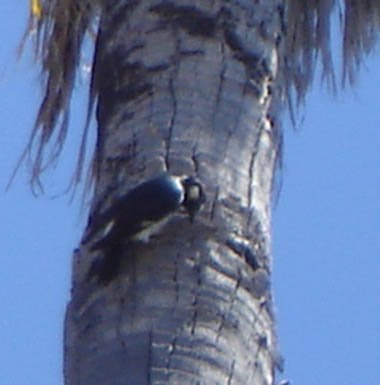
I'm also taking my digital camera along on my morning walks. I've been wanting to photograph birds for sometime now. It's good to have a photo (even if it is poor) to help remember the bird I want to identify. My goal is to become a good photographer. As you can see from the photos I took today, I have a long way to go. The photos, by the way, are of Acorn Woodpeckers (Melanerpes formicivorus) in case you can't tell. I was so excited when I saw these birds for several reasons. First, they are striking to look at . . . sorry my photos don't show how beautiful they are. And yes, they do have red "caps" on their heads. And their behavior is just as appealing as their bright little black and white suits. As you can see the single bird in the photograph (above) was in the company of two others (left). Time slipped by quickly as I watched these gregarious, social birds.
We have oak trees in our neighborhood and it seems reasonable to assume that the "nut" I saw one of them trying to store in a hole was actually an acorn. It was interesting to watch the bird try to find the right hole in the palm tree to fit the acorn. That is another aspect of their behavior ... storing food. I've seen photos of oak trees absolutely studded with stored acorns. I never thought I'd witness this behavior myself.
I love learning facts about birds. To this end, I've decided when I have an especially good sighting or see a new bird that I'll spend some time to learn something about them. It is part of the fun of bird watching. So far, here is what I've learned about Acorn Woodpeckers:
The size of Acorn Woodpeckers is 9 inches overall with a wingspan of 17.5" and they weigh about 2.8 oz. They are very vocal and were constantly chattering and calling to each other while I watched them. The sound they make is quite distinct and pretty much unforgettable. It will most likely be one of the first bird sounds that I'll be able to identify when I go to my Birding By Ear class tomorrow morning.
Besides being cavity nesters, they store food. All the food storage that goes on is to build a cache of food to carry them through the winter. These woodpeckers have an investment to protect so are very territorial and vigoroulsy defend their "grainery". This defense is not only against other Acorn Woodpeckers, but also against squirrels and jays. To store the food an Acorn Woodpecker will excavate a hole in the tree or telephone pole to hold the acorn. It takes from 30 to 60 minutes of drilling time to make the hole. That's pretty awesome and almost unbelievable when up to 11,000 holes have been found in a tree. No wonder they have a strongly ingrained defense mechanism. They have a lot of time and energy invested storing the food they must have to survive. Acorn Woodpeckers will also defend trees that are riddled with empty holes.
Then there is polyandry. What is that? Well, it is where females pair with several males. The males then incubate the eggs and care for the young. The females defend territories, compete for mates and take the lead in courtship. There are two types of polyandry -- classic and cooperative. Classic is where the female divides her attention among two or more mates. Cooperative polyandry is where several males cooperate to assist a female. Acorn Woodpeckers fall into the 'cooperative' group.
One other aspect of Acorn Woodpeckers is also fascinating . . . they form family groups. There are several factors which lead to this type of cooperative social unit. First, there may be a shortage of quality territories which discourages dispersal of the young woodpeckers. Or there may be a food shortage during dry years which leads to recruitment to help feed the young. More recent theories suggest that along with habitat saturation there may be social benefits, such as improved survivorship and the learning of skills which creates an extended period of apprenticeship.
I've learned just enough about Acorn Woodpeckers to whet my appetite find out more. Guess I'll have to add a book to my "I-want" list that provides more information on Acorn Woodpeckers.
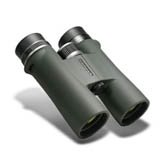 Be forewarned . . . I just realized that this blog entry has become a billboard. But for good reason that you'll appreciate, especially if you are in the market for new quality binoculars.
Back in February I discovered the binoculars I hoped to own one day. I found them at the Eagle Optics display at the San Diego Bird Festival. I'd been dreaming about getting a really fine pair of binoculars but knew they would cost in the neighborhood of $1,500 or maybe even higher. Prior to attending the Bird Festival I'd shopped a little in my local area. I casually looked at a pair or two of the high-end optics and then immediately lowered my sights to a more affordable price. Not that they wouldn't have been nice to have ... they were just too expensive. Although I found a pair of lower-priced binoculars that would have worked, they weren't much different than what I'd been using. My dream was to improve on that -- although I don't have much to complain about with my old standbys.
Anyway, at the Bird Festival all the great optics were there to compare. And compare, I did. I discovered what really good optics are all about and the clarity and brightness that comes with superior glass and coatings. The advice of "don't sneak a peak through someone's top-of-the-line optics if you intend to be satisfied with your moderately-priced ones" was good . . . but a little late for me 'cause I'd already looked.
I found some $1,600 binoculars that were impressive, to say the least. If not in quality, for sure in dollars. Just kidding ... the quality was superb. Then I did a reality-check. Should I spend so much money ... no, I shouldn't. So I kept wandering around the optics display area and finally got to Eagle Optics. This company represents many (probably all) manufacturers and they've been in business since 1986. It is a company that knows what it's doing -- and they have a great reputation. So I decided to do some comparisons at their booth. And what did I find ... an absolutely great pair of binoculars that gave me the same quality I'd seen in the most expensive glasses I'd just been looking at. But they cost about $700 less! Whew! After taking these binoculars outside to view an Osprey nest at the top of a condemned boat, it didn't take me long to decide these were my dream binoculars. But the price was still on the high side so I needed to think about it. Fortunately, Eagle Optics does most of its business online. So no rush, I could order them when I was ready.
Well, the unexpected happened and I found myself making the decision to buy the binoculars sooner than I'd dreamed. It was a dreary, rainy day when they arrived this week. Wouldn't you know it. But I didn't let the rain stop me -- I set the diopter and took them outside. I wasn't testing their water-proofness (although I could have), but rather I just wanted to see how bright the image was. Now picture this . . . it was dark and gloomy with a very light drizzle at the time. I focused on our backyard birch trees and I could see the raindrops hanging from the branches. But here is the thing -- the raindrops were so bright they glistened like little stars and the whole scene was crisp and beautiful. I couldn't believe the image could be so bright when the sky was so dark. I wish I had taken a picture of it through the binoculars. I guess I could have done that ... like a mini-disigscope. What kind of binoculars did I get? I thought you'd never ask. Here are all the details in case your curiosity is getting the better of you.
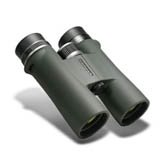
Manufacturer - Vortex
Name - Stokes DLS 8 x 42 (10x42 also available). Yep, the Stokes couldn't wait to put their name on these babies. Evidently, they are also their binoculars of choice for their own birding.
Field of View - 383 feet at 1,000 yards
Eye Relief - 18 mm
Close Focus - 4 feet 5 inches. Can you believe it? I can lay in my hammock and have a front row seat watching the hummingbirds at the feeder just above my head. This close focus is also superb for butterfly watching.
Dimenions (HxW) 5.5 x 4.875 inches
Weatherproofing - Waterproof/Nitrogen Purged
Vortex VIP Warranty - If my binoculars should ever require service, no matter what the case, Votex will repair or replace the binoculars absolutely FREE. The warranty is even transferable, but it doesn't cover theft, loss or deliberate damage. But that's only fair. It's a great warranty but one that will never by transferred by me. I'm not letting go of these binocs.
Eagle Optics 30-day Guarantee - I have the right to return the binoculars to Eagle Optics within 30 days if I'm not satisfied, less return shipping charges No chance of that! ... but nice to know.
At the risk of sounding like an Eagle Optics employee, here's more: These binoculars have 64-layer premium mirror-coated BaK-4 deviation prisms with the latest generation of phase corrected prism coatings.
The Total Optical Performance System gives you:
Pure silver coated, phase-corrected prisms for the highest image contrast and resolution.Precisely engineered and enhanced optical tube design to eliminate annoying glare and image ghosting. (Roof prism design . . . pictured above)
High-density prism glass and lens elements for exceptional image brightness and sharpness. That sure is the truth!
Twilight optimized multi-layered lens element coatings for optimal low light performance. Guess this why my raindrop image was so bright and clear. Highly polished and precision shaped lens elements and prisms for true flat field performance and minimal spherical distortion.
XHR (eXtremely High Resolution) fully multi-layered coatings to deliver excellence in resolution and color fidelity. No doubt about that.
Precisely designed optical system for particularly clear and precise focusing from extremely close range to infinity.
Smooth focus with just the touch of a finger -- fast enough to stay with warblers hopping as close as 4.5 feet, or swallows flying erratically out to infinity.
Optimum near-to-far focus travel reacts swiftly in 1.25 revolutions.
Soft, contoured eyecups can be locked in place when fully extended.
Multiple eye relief settings are accessed by twisting down the eyecups for wide, unobstructed views with eyeglasses.
Superb depth of field let you find and follow wildlife more easily.
Click-stop diopter control is conveniently located adjacent to the right eyepiece for precise adjustments for differences in your eyes.
Okay, okay so I got carried away with all the details. Forgive me. I couldn't help myself -- I'm so excited about these binoculars. In fact, before buying them I decided to do some research to figure out what all the techno-speak stuff was about. I learned enough to really appreciate what these DLS Binoculars offer. Now that I understand what it takes to have a good pair of birding binoculars I put together an easy primer so anyone can understand the basics. This is a primer that beginning birders might find especially useful. The primer will be available soon at Birding Binoculars so check back if you're interested.
The bottom line is that choosinbg binoculars is a very personal decision. With so many binoculars and manufacturers to choose from I'm grateful to have found the perfect ones for me. My suggestion is if you're in the market for quality binoculars check them out -- they may be the absolute end-all, perfect ones for you, too.
I never realized the impact blogging would have on me. I never realized I'd have so much fun writing about the going-ons in my life. I suppose that's because I've always been kind of a private person. But what do you know ... here I am writing about my life almost daily. And surprise of surprises ... I enjoy it. Who would have thought.
But the best part of blogging is the people I've met. It's been amazing. I have new friends in Australia, Singapore and most recently Costa Rica. And those exotic places don't lessen the impact of those I've met here in the U.S. And then there are the blogs these people and others write. There is a growing list of My Favorite Blogs over on there on the right. There are certainly many talented folks out there in cyberland and they bring insight and humor to my life daily. Computers are wonderful inventions.
My newest acquaintance from Costa Rica authors A Broad In Costa Rica . . . the play on words in the title is just an inkling of humor you'll discover as she writes about her family's adventures as new residents in Costa Rica. Don't miss it.
I also discovered a service on her blog offered by FeedBlitz that allows people to subscribe. What this means is that you'll get an email when there is a new post. Of course, XML syndication is available, too ... as it is on my blog (just over there to the right). But people seem to get confused over how that works and it's said that about 80% of potential subscribers avoid XML because they just don't understand it. Now I really don't know if anyone feels the need or desire to subscribe to my blog, but I thought I'd offer a subscription opportunity, too. Afterall, it's nice to think that I might contribute something about my interest in birds that others might find worth revisiting. So in case that's true and you'd like to get an email notice of new postings then just add your name to the subscribe block (over in the right column) and press Subscribe Me. Your information will be as confidential as you choose it to be. And be assured this is not something that will generate spam or any privacy issues.
I found a good way to make new friends is to leave comments on blogs . . . or on websites. So if you have a comment, something to share, or maybe a request just let me know. I'll do my best to respond.
Today is going to be full of non-birding activities until tonight. Then I get to go the second meeting of the Beginning Birding Class I wrote about yesterday. I'm ready and enthusiastically looking forward to what the next birding pro will share. Besides the birds themselves, it's the people you meet in the birding world that can be just as fascinating. More on the birding class tomorrow.
 When I received an email promoting a beginning birding class sponsored by the Buena Vista Audubon Nature Center I just couldn't resist signing up. Although I've been birding for awhile I was curious to see what an official birding class had to offer. Besides the BV Nature Center is close enough that I can get my nighttime pet bird chores done and still make it on time. So last Wednesday off I went.
First of all, the Nature Center is a pretty cool place. It is set adjacent to Buena Vista Lagoon in Oceanside (northern San Diego County). The Center is primarily devoted to educating children and they do a great job.
There are many bird specimens which really help to appreciate and remember the field marks of those species. Fortunately, the Nature Center has a volunteer who does taxidermy and she offers her services for free. I was very happy to hear that all the specimens were found in a deceased condition within Buena Vista Lagoon. I'm a real bleeding heart and I don't think I could bear hearing that the birds were captured for taxidermy purposes. I'm afraid if that were the case my experience at Buena Vista would have been ruined. I can't help it ... I just don't deal well with animal death. I know I need to be realistic and I am to a point. But the bottom line is I am a real bleeding heart and I struggle dealing with it.
Anyway, the first class was informal because it was combined with a general meeting of the BV Audubon Society. There was a guest speaker from another Nature Center in the San Diego area. She was a very experienced birder who has been birding for about 35 years. While her talk was informal it was interesting and focused on the mystery and magic of birds. A slide presentation of field marks accompanied her talk.
Then last Saturday we had a field trip to the Lagoon area of the Nature Center -- Buena Vista Lagoon, to be exact. The field trip included an informal talk on "Introduction to Birding" focusing on the birds of fresh water wetlands. The field trip began at 8:30 a.m. That meant rushing around to get morning bird chores done before I could leave. I was organized and out the door in time to get to the field trip on time, but in my rush forgot my binoculars. Did I say I was organized? Evidently, not well enough. Sheesh! I thought only I could pull a stunt like that, but found out later that people who've been birding forever have been known to do the same thing. But I really felt foolish and had to rely on the trip leader's scope to see my birds.
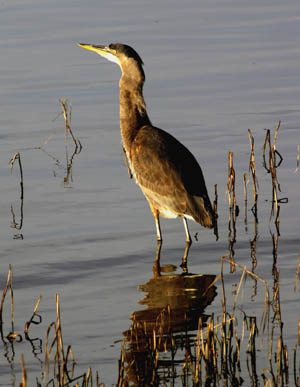
Here is the list of what I saw: Pied-billed Grebe, Western Grebe, White Pelican, Great Blue Heron, Mallard, Cinnamon Teal, Northern Shoveler, Gadwall, Ruddy Duck, Osprey, Red-tailed Hawk, Common Moorhen, American Coot, Black-necked Stilt, Ring-billed Gull, Anna's Hummingbird, Cliff Swallow (and their nests under a bridge), American Crow and Marsh Wren. Not bad for standing in one spot for a couple of hours. We'll have four more class meetings along with field trips. Each field trip will be to a habitat that provides an opportunity to use skills and see the types of birds covered in the previous class meeting. The last field trip will be to participate in the Buena Vista Audubon Society's Birdathon--America's Birdiest City Contest. The Beginning Birder's Class will form a team to participate in this event to test their new skills. Should be fun and a great way to finish the class.
Then on April 15th I'm going to attend a Birding By Ear class also sponsored by BVAS. I'm really looking forward to it because identifying birds by their song will be new to me. I just haven't put much effort toward learning those skills. More on that later.
I should have my new binoculars for the next field trip. I can't wait to get them ... they will be my first real high quality optics. I'm getting an Eagle Optics Bino System Harness strap, too. With that gadget I can hang my binocs around my neck in comfort and without them swinging around. They tell me that these straps are the way to go. So I'll hang my new binocs around my neck before I leave the house. I don't think I could deal with forgetting them twice.